Is the Papacy a Medieval Invention?
Short Answer
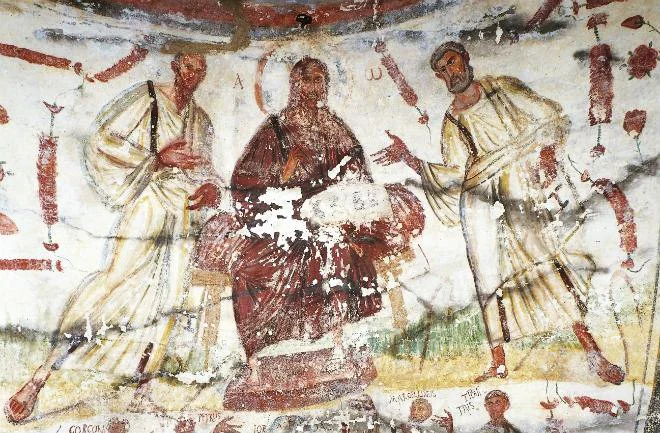
Christ with Saints Peter and Paul, fourth century, Catacomb of Saints Marcellinus and Peter, Rome. Ancient Roman Christians were depicting Peter and Paul as principal apostolic figures centuries before the medieval period. This surviving catacomb painting belongs to the same early Christian world in which writers such as Clement, Irenaeus and Cyprian were already speaking of Rome’s apostolic succession, authority and the Chair of Peter.
No. The papacy is not a medieval invention. The claim collapses when confronted with the documentary record of Christianity’s first centuries.
Long before Constantine legalised Christianity, long before the fall of the Western Roman Empire, and many centuries before the medieval period, Christians were already speaking of:
Peter's unique place among the Apostles;
the succession of bishops at Rome from Peter;
the Roman Church as an authoritative standard of apostolic faith;
Rome intervening in disputes outside its own local territory;
the Roman See as the Chair of Peter;
Rome as a centre of ecclesiastical unity;
Christians throughout the world maintaining communion with the Roman Church.
Around AD 96, while the Apostle John was probably still alive, the Church of Rome intervened in a serious dispute at Corinth. Its letter did not merely offer friendly advice: it warned that those who disobeyed what had been written through Rome would place themselves in serious spiritual danger.
Around AD 107, St Ignatius of Antioch addressed the Roman Church in language unlike that which he used for the other local churches, describing it as the Church which “presides” and “presides over love.”
Around AD 180, St Irenaeus of Lyons appealed to the succession of the bishops of Rome as the decisive public witness against heresy and stated that every Church must agree with Rome because of its “preeminent authority.”
Around AD 200, Tertullian challenged heretics to produce an apostolic succession comparable to Rome's and specifically connected the Roman succession with Peter.
Around AD 250, St Cyprian of Carthage called Rome the “throne of Peter” and the “chief church whence priestly unity takes its source.”
These are not medieval witnesses. They belong to Roman imperial Christianity—when becoming Bishop of Rome could lead not to a palace, but to exile, forced labour, imprisonment or death.
The medieval-invention theory therefore gets the chronology backwards. Medieval Christians did not manufacture a Roman primacy out of nothing. They inherited an institution whose roots are visible in Scripture and whose Roman succession, authority and role in ecclesial unity are documented centuries before the Middle Ages.
Why This Question Matters
A common objection to Catholicism runs like this:
Jesus founded Christianity, but the early Church was a loose federation of independent Christian communities. Centuries later, ambitious Roman bishops gradually accumulated power until the medieval papacy emerged.
If that account were true, we should expect the earliest Christian evidence to know nothing of a distinctive Roman authority. But that is not what we find.
We find the Church of Rome intervening in another Church's affairs before AD 100.
We find second-century Christians identifying Rome with the apostolic succession of Peter and Paul.
We find Irenaeus using communion with Rome as a public test against heresy.
We find third-century Christians speaking of the Chair of Peter at Rome.
We find fourth- and fifth-century Fathers explicitly connecting ecclesial unity with Peter's Roman chair.
And at Chalcedon in AD 451, Eastern bishops famously acclaimed Pope Leo's doctrinal Tome with the words:
“Peter has spoken thus through Leo.”
Whatever arguments may be made about the precise exercise of papal jurisdiction at different periods, this is not the documentary footprint of an office invented in medieval Europe.
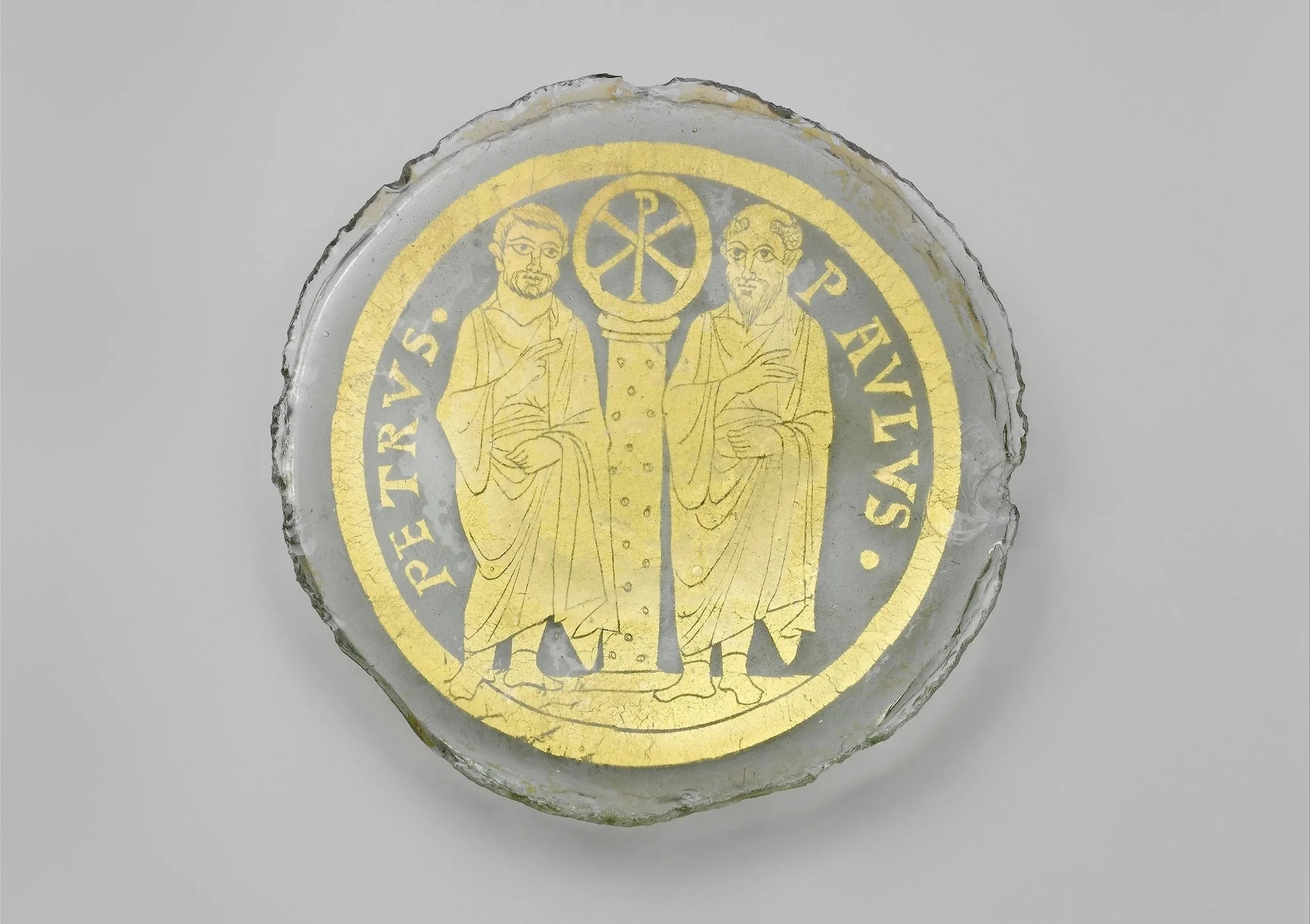
Saints Peter and Paul, late fourth century. This early Christian gold-glass medallion depicts the two Apostles traditionally associated with the Church of Rome, flanking the Chi-Rho of Christ. Long before the Middle Ages, Christians were already preserving Rome’s apostolic identity through Peter and Paul. The historical evidence for the Roman Church and its Petrine succession begins in Christian antiquity—not in medieval Europe.
What Did Christ Establish?
The argument does not begin with Rome. It begins with Peter.
Christ Gives Peter the Keys
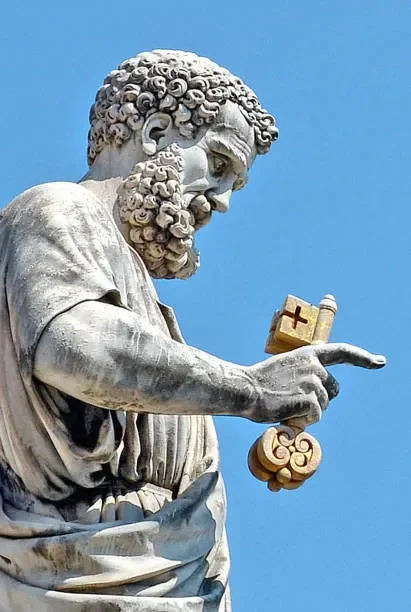
Statue of St Peter holding the keys, St Peter’s Square, Vatican City. The keys recall Christ’s words to Peter: “I will give to thee the keys of the kingdom of heaven” (Matthew 16:19). They symbolize the unique authority entrusted to Peter and, in Catholic teaching, continued in his successors in the Roman See. Long before the medieval period, the Church Fathers were already identifying Rome with the Chair of Peter, apostolic succession, and the visible unity of the Church.
Christ says to Simon:
“Thou art Peter; and upon this rock I will build my church, and the gates of hell shall not prevail against it. And I will give to thee the keys of the kingdom of heaven.” — Matthew 16:18–19
The imagery is governmental. Christ does not merely tell Peter that he is an important Apostle. He gives him the keys of the kingdom.
The Old Testament background is particularly significant. In the Davidic kingdom, the king possessed a chief steward who exercised authority under him. Isaiah describes this office:
“And I will lay the key of the house of David upon his shoulder: and he shall open, and none shall shut: and he shall shut, and none shall open.” — Isaiah 22:22
Christ is the Messianic Son of David.
He possesses the Kingdom absolutely.
Peter receives the keys under Him.
Biblical Pattern
DAVIDIC KING
↓
CHIEF STEWARD
↓
KEY OF THE HOUSE OF DAVID
↓
AUTHORITY TO OPEN AND SHUT
and in the New Covenant:
CHRIST THE KING
↓
PETER
↓
KEYS OF THE KINGDOM
↓
AUTHORITY TO BIND AND LOOSE
The resemblance is not accidental ornamentation. Matthew deliberately records Christ using the language of keys, binding and loosing in connection with the establishment of His Church.
Peter Must Strengthen His Brethren
At the Last Supper Christ tells Peter:
“Simon, Simon, behold Satan hath desired to have you, that he may sift you as wheat: But I have prayed for thee, that thy faith fail not: and thou, being once converted, confirm thy brethren.” — Luke 22:31–32
There is an important distinction in the passage.
Satan desires all the Apostles.
Christ particularly prays for Peter.
Peter is then commanded to strengthen his brethren.
Peter Must Feed Christ's Entire Flock
After the Resurrection Christ three times commissions Peter:
“Feed my lambs.”….“Feed my lambs.”….“Feed my sheep.” — John 21:15–17
Peter is therefore associated in the Gospel record with:
THE ROCK
THE KEYS
BINDING AND LOOSING
CONFIRMING THE BRETHREN
FEEDING CHRIST'S FLOCK
The papacy does not begin with a medieval king deciding that the Bishop of Rome should become powerful. It begins with the peculiar commission Christ gave to Simon Peter.
But Peter Died—Why Should His Office Continue?
This is the next essential question. If Peter's function existed merely because of his personality, it could disappear with Peter. But Christ established His Church for all generations.
The need for visible unity did not disappear when Peter died. Nor did the apostolic offices simply vanish as their original occupants died. The New Testament itself demonstrates the principle of succession in ecclesiastical office. After Judas died, St Peter cited Scripture:
“His bishopric let another take.” — Acts 1:20
Matthias was selected to occupy the office left vacant by Judas. The Catholic claim is therefore not that another man somehow became the Apostle Peter biologically or personally.
Rather:
PETER DIES
↓
THE PETRINE OFFICE DOES NOT CEASE
↓
ANOTHER BISHOP OCCUPIES PETER'S SEE
↓
THE SUCCESSION CONTINUES
This is precisely what the early Christian historical record says happened at Rome.
Why Rome?
This deserves a careful answer because an obvious question arises:
Why Did Christianity Not Have Its Headquarters in Jerusalem?
After all:
Christ was crucified and rose in Jerusalem;
Pentecost occurred there;
the Apostles initially preached there;
the first Christian community was there;
St James governed the Church of Jerusalem;
the first council recorded in Acts took place there.
Why, then, Rome?
Because Primacy Follows Peter—not the Geography of the Holy Land
Catholic doctrine does not teach:
Rome was the capital of the Empire, therefore the Bishop of Rome became pope.
That would make the papacy a political institution. The order is the reverse.
Christ entrusted the primacy to Peter.
Peter eventually established his final apostolic See at Rome and was martyred there.
His successor in that See therefore succeeded to the Petrine office.
The First Vatican Council would eventually define explicitly that Peter has perpetual successors in the primacy and that the Roman Pontiff succeeds Peter in that primacy.
Rome is important because it became Peter's See. Peter did not become important because he went to Rome.
That distinction is fundamental.
Jerusalem Had an Apostle—But Not Peter's Primatial See
Jerusalem certainly possessed immense dignity. Its first bishop was St James the Just.
Eusebius records an actual succession of bishops of Jerusalem beginning with James and continuing after him. This is important because it demonstrates that Catholics do not need to diminish Jerusalem in order to defend Rome. Jerusalem had:
apostolic origins;
bishops;
succession;
enormous historical holiness.
But apostolicity does not mean that every apostolic see possesses Peter's primacy.
Antioch was apostolic.
Alexandria was apostolic.
Ephesus was apostolic.
Corinth was apostolic.
Jerusalem was apostolic.
Rome was distinguished by its association with Peter and Paul, and particularly by becoming the enduring See of Peter's succession.
Jerusalem Was Also Devastated
There was another historical reality. Jerusalem could hardly have developed into a permanent administrative headquarters for worldwide Christianity in the ordinary geographical sense. The city was devastated by the Romans in AD 70. The Christian community had left Jerusalem before the siege.
After the Bar Kokhba revolt, Jerusalem suffered another catastrophic transformation. Under Hadrian the city became Aelia Capitolina, and Jews were prohibited from entering. The earlier succession of Jewish-Christian bishops consequently ended and a Gentile Christian episcopate followed. Eusebius records this transformation explicitly.
But this must not be used as a false argument:
Jerusalem was destroyed, so Christians invented the Roman papacy.
That is not the Catholic case. The theological reason for Roman primacy is Petrine succession.
Jerusalem's destruction merely helps explain why it is historically mistaken to imagine that Christianity naturally ought to have retained Jerusalem as an administrative capital analogous to the later Vatican.
Rome Was Providentially Positioned at the Centre of the Pagan World
There is also a striking historical dimension. Rome was the centre of the empire. Roads and sea routes connected it with vast territories. People, soldiers, merchants, officials and ideas moved through it.
The Gospel did not remain confined to Palestine. Christ had commanded:
“Going therefore, teach ye all nations.” — Matthew 28:19
And Christianity's visible centre ultimately appeared not in an isolated sanctuary but inside the capital of the pagan empire that was persecuting it. That is extraordinary.
The Christians did not conquer Rome militarily.
Peter arrived without an army.
He possessed no palace.
He controlled no treasury.
He commanded no imperial legions.
And according to ancient Christian tradition, he died there as a martyr.
The Roman See was therefore not born because Christianity captured the Roman state.
The Roman state was killing Christians while the Roman Church was already developing its extraordinary place within Christianity.
Around AD 96: Rome Intervenes at Corinth
This is one of the most devastating pieces of evidence against the medieval-invention theory.
A serious dispute arose in Corinth. The extraordinary fact is not simply that another Christian community heard about it. The Church of Rome intervened.
The document traditionally known as 1 Clement was written from Rome to Corinth around the end of the first century. Its opening reads:
“The Church of God which sojourns at Rome, to the Church of God sojourning at Corinth…”
Rome then addresses the disorder in Corinth at considerable length. Near the conclusion comes something much stronger than:
Here is our opinion; do with it what you like.
The Roman Church warns that anyone who disobeys what God has spoken “through us” places himself in transgression and serious danger. It sends representatives and asks Corinth to report back when peace has been restored.
Consider the date. Approximately AD 96
Not 1096.
Not 1296.
Not the Renaissance.
Not after Constantine.
The first century.
The Apostle John may still have been alive. Yet when the Church of Corinth suffered a grave internal crisis, Rome intervened across the Mediterranean.
That does not by itself contain every later canonical formulation of papal jurisdiction. But it makes the theory of a completely autonomous early Christianity followed by a medieval Roman takeover exceedingly difficult to sustain.
Around AD 107: Ignatius of Antioch and the Church That “Presides”
St Ignatius of Antioch was travelling to Rome to be martyred. He wrote letters to several Christian churches. But his greeting to Rome is extraordinary. He describes the Roman Church as worthy of God, honour and praise, and says that it “presides” and “presides over love.”
This is approximately two centuries before Constantine. Ignatius was not flattering an imperial Christian establishment. There wasn't one. He was a condemned Christian bishop being transported to the capital of the empire to die.
And he writes with exceptional reverence toward the Roman Church.
Around AD 180: Irenaeus Makes Rome a Test of Apostolic Christianity
The evidence becomes even more explicit with St Irenaeus of Lyons. Irenaeus was fighting the Gnostic heresies. How could ordinary Christians know what the Apostles had actually taught?
His answer was apostolic succession. Instead of trying to catalogue every apostolic Church, Irenaeus points especially to:
the very great, very ancient and universally known Church at Rome founded and organised by Peter and Paul.
He then lists its episcopal succession. And he says that because of Rome's preeminent authority, every Church must agree with it. The importance is enormous.
Date: approximately AD 180.
Irenaeus does not say:
Someday the Bishop of Rome may acquire authority.
He appeals to the already existing authority and succession of the Roman Church as evidence capable of refuting heretics. And he was writing from Gaul, not Rome.
Around AD 200: Tertullian Points Heretics Toward Rome
Tertullian similarly challenges heretical groups to demonstrate their apostolic pedigree. Let them produce, he says, the records of their churches. Let them show the succession of their bishops back to an Apostle. He then gives examples.
Smyrna traces its succession through Polycarp to John.
And Rome traces its succession through Clement to Peter.
Tertullian then directs Christians toward the apostolic Churches and singles out Rome, from which apostolic authority was available to Christians in the West.
Again: Around AD 200.
Still no Constantine.
Still no medieval Europe.
Still no Papal States in their later form.
But:
PETER → ROMAN SUCCESSION → APOSTOLIC AUTHORITY
is already part of Christian argumentation against heresy.
Around AD 250: Cyprian Calls Rome the Chair of Peter
St Cyprian of Carthage is particularly valuable because he was not a papal absolutist. He famously disputed with Pope Stephen over the rebaptism of heretics. Therefore Cyprian cannot simply be dismissed as a Roman propagandist. Yet Cyprian's own writings contain remarkably Petrine language. Writing concerning schismatics travelling to Rome, he describes them as daring to approach:
the throne of Peter
and the:
chief Church whence priestly unity takes its source.
Elsewhere Cyprian speaks of Christ building the Church upon Peter as the source and principle of unity. And when discussing the election of Pope Cornelius, Cyprian identifies the vacant Roman episcopal place with “the place of Peter.”
This is the middle of the third century. The vocabulary may not yet be that of the First Vatican Council, but the underlying ideas are unmistakable:
PETER
↓
A CHAIR
↓
ROME
↓
SUCCESSION
↓
ECCLESIAL UNITY
That is extraordinarily difficult to reconcile with the claim that Petrine Roman primacy was invented a thousand years later.
Fourth Century: “In the One Chair Unity Should Be Preserved”
St Optatus of Milevis, writing against the Donatist schism, makes the argument still more explicit. He asks who first occupied the episcopal chair and where. His answer is Rome. Peter first occupied that chair, he says, so that in this one chair unity should be preserved, and he then proceeds through the Roman succession from Peter to Linus and onward.
Notice again what Rome represents:
not merely prestige,
not merely antiquity,
not merely the former imperial capital,
but visible ecclesiastical unity centred upon the chair associated with Peter.
St Jerome: Communion with the Chair of Peter
St Jerome likewise wrote:
“I … am in communion with Your Holiness, that is with the chair of Peter.”
He connects communion with Peter's chair to the rock upon which the Church is built. Again, this is patristic Christianity. Not medieval scholasticism.
AD 451: “Peter Has Spoken Through Leo”
Then comes the Council of Chalcedon. Pope St Leo the Great's Tome was read concerning the doctrine of Christ. The bishops famously acclaimed:
“Peter has spoken thus through Leo.”
Whatever later disputes exist concerning the precise interpretation of Chalcedon's proceedings, one fact cannot reasonably be erased:
fifth-century bishops could understand the Bishop of Rome through the category of Peter continuing to speak through his successor.
That is roughly 600 years before the First Crusade and more than 400 years before the conventional beginning of the High Middle Ages.
Calling the papacy a medieval invention therefore requires one to redefine “medieval” until it includes much of Christian antiquity.
The Early Roman See Was Not a Glamorous Prize
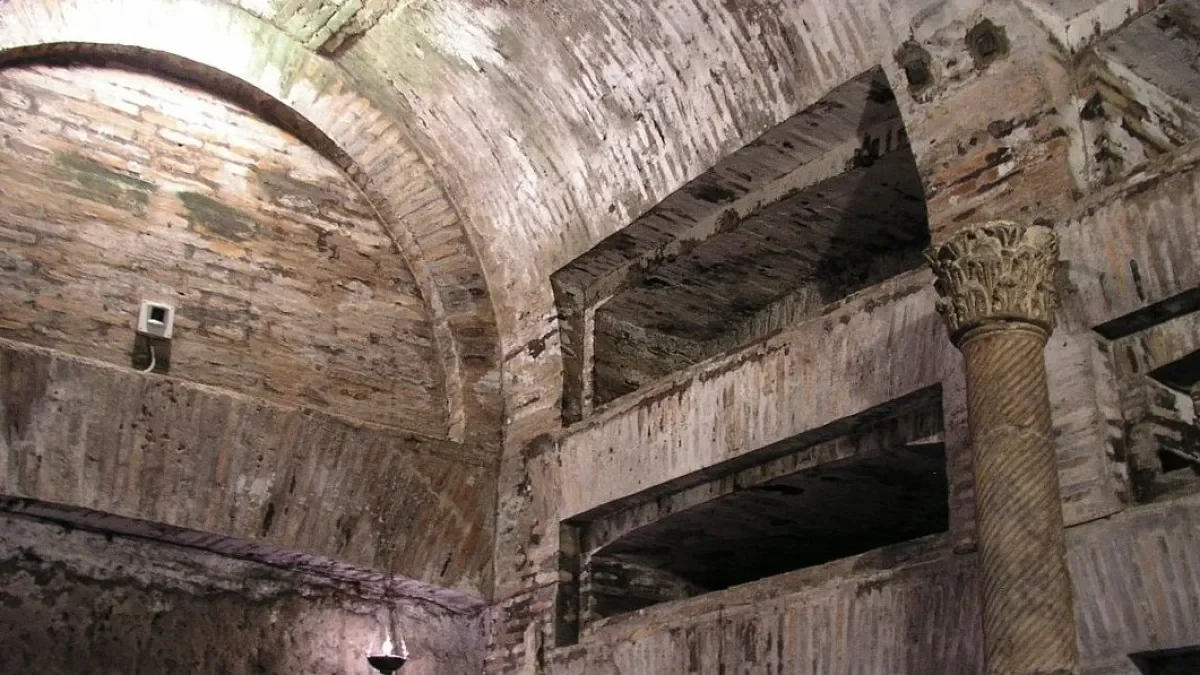
The Crypt of the Popes in the Catacomb of St Callixtus, Rome. Several third-century bishops of Rome were buried here, including Pontian, Anterus, Fabian, Lucius and Eutychian. Their simple tombs belong to an age when the Roman episcopate existed under persecution—centuries before the medieval papacy.
There is another historical fact that deserves far greater emphasis. Modern people can unconsciously project the later Vatican backwards into the first centuries. They imagine:
palaces,
diplomatic corps,
ceremonial courts,
art collections,
international prestige,
temporal territories,
and political influence.
Then they imagine ambitious clerics inventing the papacy in order to possess those things.
That picture is historically backwards. For the earliest Roman bishops, becoming Bishop of Rome could mean becoming a conspicuous Christian leader in the capital of an empire that periodically persecuted Christians. The chair could be a path to martyrdom.
Peter: Crucified at Rome
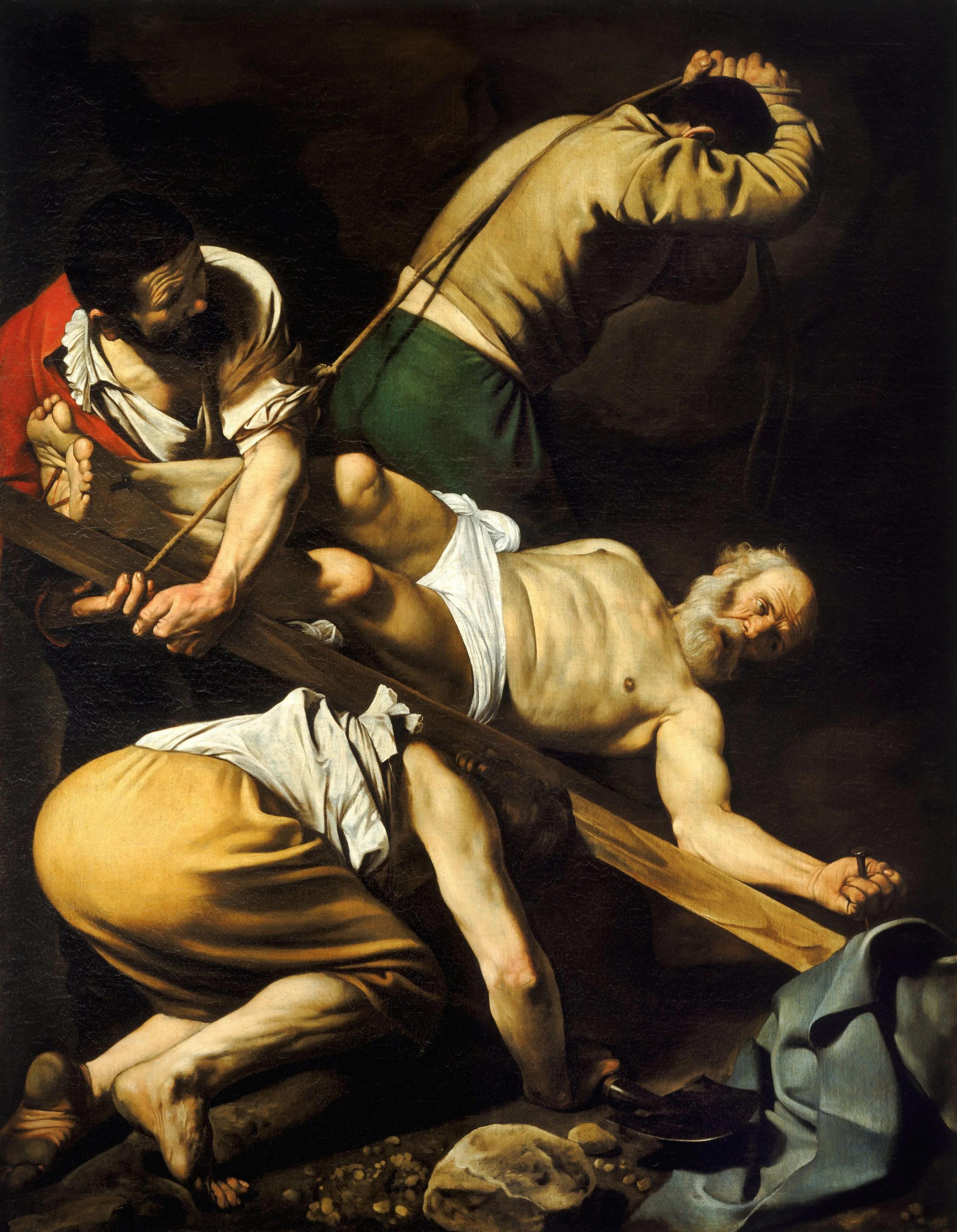
The Crucifixion of St Peter — Caravaggio, c. 1600. According to ancient Christian tradition, St Peter was crucified at Rome under Nero and requested to be crucified head downward, considering himself unworthy to die in the same manner as Christ. Caravaggio depicts the brutal physical reality of the martyrdom: the Apostle, already an old man, is being raised on the inverted cross that will become the instrument of his death. The scene is a powerful reminder that the Roman See did not begin as a throne of medieval privilege. Its first bishop, according to ancient tradition, ended his ministry in Rome not in a palace, but on a cross.
The ancient Christian tradition places St Peter's martyrdom at Rome during the persecution of Nero. Eusebius records Peter and Paul's martyrdom there and the subsequent succession of Linus to the Roman episcopate.
Peter therefore did not establish a Roman dynasty from a palace. He sealed his apostolic ministry with his blood.
Pope St Telesphorus
Ancient Christian tradition identifies Pope Telesphorus, who governed during the second century, as having suffered martyrdom. This is significant because Irenaeus himself—writing in the second century—remembered Telesphorus as having borne glorious martyrdom.
Here we are extremely close historically to the event.
Pope St Pontian: Sent to the Mines
Pope Pontian was deported under imperial persecution to the mines of Sardinia. The conditions were so severe that he relinquished his office so that the Roman Church would not remain without effective leadership. He died after his treatment in exile. His remains were later returned to Rome.
That is worth contemplating. A man does not accept the Roman episcopate in such an age because it promises Renaissance splendour. It could promise chains and a Sardinian mine.
Pope St Fabian: Martyred Under Decius
Pope Fabian was killed during the Decian persecution in AD 250. His martyrdom is historically secure. His tomb was discovered in the Catacomb of St Callistus bearing the Greek inscription identifying him as:
FABIAN — BISHOP — MARTYR.
Archaeology therefore literally preserves the memory of a Roman bishop who died for the Faith.
Again: AD 250.
No medieval papal monarchy.
No Christian Roman Empire.
A bishop and martyr.
Pope St Sixtus II: Seized During the Liturgy
During the Valerian persecution in AD 258, Pope Sixtus II was arrested and executed.
The image could scarcely be further removed from the caricature of an office invented for worldly power.
The Bishop of Rome was a target because he was a Christian leader.
Later Popes Also Suffered
Even after Christianity became legal, the papal office was by no means guaranteed safety.
Popes endured:
imprisonment;
political coercion;
exile;
physical mistreatment;
deposition;
captivity;
and, in some cases, violent death.
Pope St John I died after imprisonment under the Ostrogothic king Theodoric.
Pope St Martin I was arrested in the seventh century, transported to Constantinople, publicly humiliated, imprisoned and exiled after refusing to compromise the Faith concerning the Monothelite controversy.
Other pontiffs suffered exile or violence amid the political conflicts of later centuries.
But Accuracy Matters
It is sometimes claimed that “the first 32 popes were all martyred.”
That should not be presented as an established historical fact.
Ancient tradition venerates many early Roman pontiffs as martyrs, but the historical evidence is not equally secure for every individual pope.
The stronger argument does not require exaggeration.
What can be demonstrated is already formidable:
The Roman episcopate existed and possessed recognised ecclesiastical significance during centuries in which occupying it could expose a man to persecution, exile, forced labour or death.
That historical reality is devastating to the theory that the papacy originated as a medieval scheme for political prestige.
The Historical Sequence
Put the evidence on one timeline:
Approx. DateEvidenceWhat It Establishesc. AD 30–33Matthew 16; Luke 22; John 21Peter receives a distinctive commissionc. AD 64–67Peter martyred at RomePetrine ministry becomes permanently associated with Romec. AD 96Clement / Church of Rome writes to CorinthRome intervenes authoritatively beyond its local Churchc. AD 107Ignatius to the RomansRoman Church described as uniquely “presiding”c. AD 180Irenaeus, Against Heresies III.3Roman succession from Peter; agreement with Rome linked to apostolic truthc. AD 200Tertullian, Prescription Against HereticsRome's episcopal succession traced to Peterc. AD 250CyprianRome called the Chair of Peter and chief Church/source of priestly unityAD 250Fabian martyredRoman episcopate still exposed to lethal persecutionAD 258Sixtus II executedRoman bishop again suffers under imperial persecutionc. AD 370sOptatusPeter's Roman chair presented as visible centre of unityc. AD 370s–380sJeromeCommunion with Rome identified with communion with Peter's chairAD 451Chalcedon“Peter has spoken through Leo”AD 1870Vatican IAncient Petrine-Roman doctrine precisely defined against modern controversy
Look at the chronology.
The doctrine does not suddenly appear in AD 1200.
The evidence forms a continuous trajectory beginning in apostolic and patristic Christianity.
But Did the Early Popes Exercise Power Exactly Like Later Popes?
No—and Catholicism does not require that they did.
This objection confuses an office with the historical circumstances in which that office is exercised.
The United States presidency of George Washington did not possess:
nuclear command systems;
Air Force One;
instant electronic communication;
a gigantic federal bureaucracy;
modern executive agencies.
That does not mean the presidency did not exist.
Likewise, Peter did not possess:
a Vatican secretariat;
apostolic nunciatures;
printed canon-law collections;
telephones;
global communications;
modern diocesan reporting systems.
None of those things constitutes the papacy.
The doctrinal question is whether the Church recognised a continuing Petrine authority in the Roman See.
The early evidence demonstrates the constituent elements progressively and unmistakably:
Peter
↓
special commission
↓
Roman ministry and martyrdom
↓
Roman episcopal succession
↓
Chair of Peter
↓
centre of ecclesial communion
↓
authority extending beyond Rome
↓
guardian of apostolic faith and unity
The administrative mechanisms developed.
The office was not thereby invented.
Main Objection: “Rome Only Had a Primacy of Honour”
This is probably the strongest serious objection, particularly from Eastern Orthodox Christianity.
It acknowledges that Rome was ancient, apostolic and highly respected but argues that Rome possessed merely a primacy of honour, not universal jurisdiction.
There is an important truth contained in the objection:
the full technical terminology eventually employed by Vatican I is not found word-for-word in every second-century text.
Historical development in terminology and canonical administration unquestionably occurred.
But the objection becomes inadequate when it attempts to reduce the early evidence to ceremonial honour.
Ask what the sources actually show.
Was Clement merely honoured?
No. Rome intervened in Corinth and expected its intervention to produce obedience.
Was Rome merely prestigious for Irenaeus?
No. He used Roman apostolic succession and Rome's preeminent authority as an objective test against heresy.
Was Peter's Roman chair merely honorary for Cyprian?
No. He called it the chair of Peter and described Rome as the chief Church from which priestly unity takes its source.
Was Peter's chair merely decorative for Optatus?
No. He connected it explicitly with the preservation of ecclesiastical unity.
Was Leo treated at Chalcedon merely as a distinguished Western patriarch?
The bishops acclaimed his orthodox teaching by saying:
“Peter has spoken thus through Leo.”
One may debate the scope of individual texts.
One cannot responsibly make the entire pattern disappear.
The Papacy Did Develop—But “Development” Is Not “Invention”
This distinction is crucial.
Catholics need not claim that the external administration of the papacy looked identical in AD 100, AD 500, AD 1200 and AD 1900.
It plainly did not.
What developed?
canonical procedures;
administrative institutions;
terminology;
methods of communication;
papal diplomacy;
the organisation of the Roman Curia;
relations between pope and civil rulers;
procedures for papal elections;
exercise of jurisdiction in changing political circumstances.
What did not originate in the Middle Ages?
The underlying Petrine-Roman principle:
Peter possesses a unique office of unity and government
↓
Peter's final See is Rome
↓
the bishops of Rome succeed to Peter's chair
↓
the Roman Church possesses a distinctive authority among the Churches
↓
communion with Peter's Roman chair is bound up with the visible unity of the Church
That structure is demonstrably pre-medieval.
What Vatican I Actually Defined
The First Vatican Council did not claim to invent a new office.
It defined more precisely what the Church understood the Petrine office to be.
Pastor Aeternus teaches that Christ directly bestowed upon Peter a genuine primacy of jurisdiction and that what Christ instituted for the permanent good of the Church must continue.
It therefore defined that Peter has perpetual successors in the primacy, and that the Roman Pontiff is Peter's successor in that primacy.
Significantly, Vatican I itself appealed to the ancient evidence—including Irenaeus—to support the doctrine.
The definition of 1870 is therefore not evidence that the doctrine originated in 1870 any more than the definition of Christ's two natures at Chalcedon means Christians invented Christ's divinity and humanity in AD 451.
Definition is not invention.
Councils frequently define doctrines precisely because those doctrines have been disputed.
A Simple Historical Test
Suppose the papacy really were a medieval invention.
Then we should expect something like this:
APOSTOLIC CHURCH
↓
no distinctive Petrine succession at Rome
↓
no Roman intervention outside Rome
↓
no special Roman authority
↓
no connection between Peter's chair and Church unity
↓
centuries of silence
↓
MIDDLE AGES
↓
PAPACY SUDDENLY APPEARS
But that is not the evidence.
What we actually find is:
CHRIST COMMISSIONS PETER
↓
PETER MINISTERS AND DIES AT ROME
↓
ROME PRESERVES AN EPISCOPAL SUCCESSION
↓
c. AD 96 — ROME INTERVENES AT CORINTH
↓
c. AD 107 — IGNATIUS: ROME “PRESIDES”
↓
c. AD 180 — IRENAEUS: ROMAN SUCCESSION + PREEMINENT AUTHORITY
↓
c. AD 200 — TERTULLIAN: CLEMENT'S SUCCESSION FROM PETER
↓
c. AD 250 — CYPRIAN: “CHAIR OF PETER” + CHIEF CHURCH + UNITY
↓
FOURTH CENTURY — PETRINE CHAIR EXPLICITLY CONNECTED WITH CHURCH UNITY
↓
AD 451 — “PETER HAS SPOKEN THROUGH LEO”
↓
LATER DOCTRINAL AND CANONICAL PRECISION
That is not the historical pattern of an invention.
It is the historical pattern of an institution becoming progressively more explicit in terminology and exercise while retaining an identifiable underlying principle.
What We Can and Cannot Conclude
What We Can Conclude
The historical evidence establishes that:
Peter held a unique position among the Apostles.
Ancient Christianity associated Peter with Rome and his martyrdom there.
Christians preserved a succession of Roman bishops reaching back to the apostolic period.
By the end of the first century, Rome was already intervening in the affairs of another apostolic Church.
Second-century Christians regarded the Roman Church as possessing extraordinary ecclesiastical standing.
Irenaeus explicitly connected Rome's authority, apostolic tradition and episcopal succession.
By the third century, the Roman See was explicitly described as the Chair of Peter and connected with ecclesial unity.
These ideas are therefore centuries older than medieval Christendom.
Early possession of the Roman See frequently brought danger rather than worldly security.
Consequently, the proposition that the papacy was simply invented in the Middle Ages is historically untenable.
What We Cannot Conclude
Historical precision also requires several qualifications.
We cannot claim that:
every administrative feature of the later papacy existed in the first century;
every early Christian writer articulated papal jurisdiction using Vatican I's later technical vocabulary;
every dispute between a pope and another bishop was immediately resolved in Rome's favour;
every early pope traditionally called a martyr can be historically proved to have died by execution;
every development in papal administration was itself of divine institution.
Those admissions do not weaken the case.
They clarify exactly what the evidence establishes.
The question is not:
Did the Church of AD 100 possess the Vatican bureaucracy of AD 1900?
Obviously not.
The question is:
Was there already a recognisable Petrine-Roman office and a distinctive Roman authority within ancient Christianity from which the later papacy developed?
The evidence overwhelmingly says yes.
Conclusion
The papacy is not a medieval invention.
To maintain that it is, one must somehow explain away first-, second-, third-, fourth- and fifth-century evidence that already connects Peter, Rome, apostolic succession, authority and ecclesiastical unity.
Rome was intervening at Corinth around AD 96.
Ignatius was describing Rome as presiding around AD 107.
Irenaeus was appealing to Rome's apostolic succession and preeminent authority around AD 180.
Tertullian was tracing Rome through Clement to Peter around AD 200.
Cyprian was speaking of the Chair of Peter and the chief Church from which priestly unity proceeds around AD 250.
Optatus connected the one Petrine chair with ecclesiastical unity in the fourth century.
At Chalcedon in AD 451 bishops acclaimed:
“Peter has spoken through Leo.”
And all of this occurred long before the medieval papacy.
Even the circumstances of the early Roman bishops contradict the popular caricature.
The first occupants of Peter's Roman chair did not inherit Renaissance palaces.
They lived under pagan emperors.
Some were imprisoned.
Some were exiled.
Some were sent to brutal labour.
Some were executed.
Peter himself died a martyr at Rome.
Fabian's ancient tomb still identifies him as bishop and martyr.
The papacy did not begin as a comfortable medieval throne from which ambitious churchmen accumulated prestige.
It began with Christ's commission to Peter, continued in the Roman succession, and was repeatedly defended and preserved by men for whom occupying the Chair of Peter could cost everything—including their lives.
The external structures surrounding that office developed enormously across the centuries.
The evidence for the office itself did not suddenly appear in the Middle Ages.
It is embedded in the documentary record of ancient Christianity.
Primary Sources
Holy Scripture — Matthew 16:16–19 — Christ gives Peter the rock-name and keys of the Kingdom.
Holy Scripture — Luke 22:31–32 — Christ prays particularly for Peter and commands him to strengthen his brethren.
Holy Scripture — John 21:15–17 — Christ commands Peter to feed His lambs and sheep.
St Clement of Rome / Church of Rome, First Epistle to the Corinthians (c. AD 96) — extremely early Roman intervention in the affairs of Corinth.
St Ignatius of Antioch, Epistle to the Romans (c. AD 107) — exceptional description of the Roman Church as “presiding.”
St Irenaeus of Lyons, Against Heresies III.3 (c. AD 180) — Roman apostolic succession and Rome's preeminent authority used against heresy.
Tertullian, Prescription Against Heretics 32 and 36 (c. AD 200) — apostolic succession and the Roman Church's connection with Peter.
Eusebius, Ecclesiastical History — records the ancient episcopal succession at Rome and traditions concerning Peter and Paul.
St Cyprian of Carthage, Epistles — identifies Rome with the throne or Chair of Peter and describes it as the chief Church associated with priestly unity.
St Optatus of Milevis, Against the Donatists — connects Peter's Roman chair with visible ecclesiastical unity.
Council of Chalcedon, Acts (AD 451) — reception of Leo's Tome and the acclamation “Peter has spoken thus through Leo.”
First Vatican Council, Pastor Aeternus (1870) — dogmatic definition of Petrine primacy, its perpetuity and succession in the Roman Pontiffs.
Further Reading
St Robert Bellarmine, De Romano Pontifice — systematic traditional Catholic treatment of the Roman Pontiff.
Dom John Chapman, Studies on the Early Papacy — patristic evidence concerning Roman primacy.
Adrian Fortescue, The Early Papacy — historical treatment of Roman primacy in Christian antiquity.
Joseph Fessler, The True and False Infallibility of the Popes — useful for understanding precisely what Vatican I did and did not define.
Related Questions
Did Jesus Make Peter the First Pope?
What Do the Keys of the Kingdom Mean?
Was St Peter Really the Bishop of Rome?
What Did the Early Church Fathers Believe About the Papacy?
Did the Early Church Believe the Bishop of Rome Had Universal Jurisdiction?
Why Is Apostolic Succession Necessary?
What Did Vatican I Actually Define About the Pope?
Can a Pope Teach Heresy?
Recommended Graphics & Images
1. PRIMARY GRAPHIC — RECOMMENDED
Title: The Papacy Before the Middle Ages
Visual type: Historical timeline
Insert after: Why This Question Matters
What it should show:
CHRIST COMMISSIONS PETER — c. AD 30–33
↓
PETER MARTYRED AT ROME — c. AD 64–67
↓
ROME INTERVENES AT CORINTH — c. AD 96
↓
IGNATIUS: ROME “PRESIDES” — c. AD 107
↓
IRENAEUS: ROMAN SUCCESSION + PREEMINENT AUTHORITY — c. AD 180
↓
TERTULLIAN: ROME'S SUCCESSION FROM PETER — c. AD 200
↓
CYPRIAN: “CHAIR OF PETER” — c. AD 250
↓
OPTATUS: ONE PETRINE CHAIR OF UNITY — 4th century
↓
CHALCEDON: “PETER HAS SPOKEN THROUGH LEO” — AD 451
↓
THE MIDDLE AGES HAVE NOT EVEN BEGUN
Purpose: Allow the reader to see within seconds that documentary evidence for Petrine-Roman primacy predates the medieval period by centuries.
Caption: The historical record does not show the papacy suddenly appearing in medieval Europe. References to Peter's Roman succession, Rome's authority and the Petrine chair as a principle of ecclesial unity occur throughout ancient Christianity.
Format: Original TCF infographic with TrueCatholicFaith.com discreetly at bottom.
2. Graphic: Why Rome and Not Jerusalem?
Visual type: Theological/historical flowchart
Insert after: Why Rome?
What it should show:
CHRIST DOES NOT GIVE THE KEYS TO A CITY
↓
CHRIST GIVES THE KEYS TO PETER
↓
PETER'S FINAL APOSTOLIC SEE → ROME
↓
PETER + PAUL MARTYRED AT ROME
↓
SUCCESSORS OCCUPY PETER'S ROMAN CHAIR
↓
ROME'S PRIMACY FOLLOWS PETER
Beside it:
JERUSALEM
Holy City
Christ's Passion and Resurrection
Pentecost
St James's episcopal see
Destroyed AD 70
Transformed after AD 135
↓
APOSTOLIC AND HOLY — BUT NOT THE PETRINE PRIMATIAL SEE
Purpose: Correct the misconception that Catholicism chooses Rome merely because it was the imperial capital.
Caption: Catholic teaching does not derive papal primacy from Rome's political importance. The primacy belongs to Peter by Christ's institution; Rome becomes the Petrine See because Peter established his final ministry and suffered martyrdom there.
Format: Original TCF explanatory graphic.
3. Graphic: A Throne Worth Dying For?
Visual type: Historical contrast / martyrdom panel
Insert after: The Early Roman See Was Not a Glamorous Prize
What it should show:
At top:
IF THE PAPACY WAS INVENTED FOR POWER AND PRESTIGE, ITS EARLIEST HISTORY IS A STRANGE PLACE TO LOOK FOR IT
Then selected securely documented examples:
ST PETER
Martyrdom at Rome
↓
ST PONTIAN
Deported to Sardinian mines
↓
ST FABIAN
Martyred under Decius
Tomb inscription: BISHOP • MARTYR
↓
ST SIXTUS II
Executed under Valerian
↓
ST JOHN I
Imprisoned; died following captivity
↓
ST MARTIN I
Arrested • imprisoned • humiliated • exiled
Bottom:
THE EARLY CHAIR OF PETER COULD LEAD TO CHAINS BEFORE IT LED TO PALACES
Purpose: Destroy visually the anachronistic idea that early Christians invented the Roman episcopate as a route to medieval wealth and political status.
Caption: The earliest centuries of the Roman episcopate were marked not by medieval splendour but by persecution. Historical precision does not permit us to claim that every early pope was certainly martyred, but the documented record of martyrdom, exile and imprisonment makes the “invented for prestige” caricature extraordinarily difficult to sustain.
Format: Original TCF historical graphic using authentic ancient art, catacomb imagery or document/inscription photographs where available.